
Book reading notes | ‘Careless People’ by Sarah Wynn-Williams
In a discussion about organisational culture, a colleague mentioned “Careless People” by a former Facebook employee. Although I was familiar with the title, I had not read it. She offered to lend me her copy, which I accepted, and I took it home a few days later.
“Careless People – A story of where I used to work. Power. Greed. Madness.” is authored by Sarah Wynn-Williams. She worked at Facebook from 2011 to 2017 and served as the Director of Global Public Policy.
This 400-page corporate tell-all details the issues within the organisation. Wynn-Williams remained at Facebook for six years, citing personal financial reasons for not leaving despite her concerns.
What sets Careless People apart is Wynn-Williams’ sharp, sarcastic, and humorous writing. Despite the largely negative incidents described, the book remains highly enjoyable, with humour woven throughout each chapter.
Is ‘Careless’ carelessly written?
Some contemporaries have challenged Wynn-Williams’ account. Former Facebook colleague Katie Harbath (Public Policy Director, Feb 2011 – Mar 2021) noted that while the book contains elements of truth, it also includes factual inaccuracies, exaggerations, and omissions. Her Substack article can be found here: https://anchorchange.substack.com/p/careless-people-is-careless.
This critique highlights the central tension in ‘Careless People’. While Wynn-Williams provides an authentic and revealing insider perspective, it remains a single viewpoint, and some details have been disputed by others who worked at Facebook during that time.
This doesn’t mean the book is fabricated. Memoirs, by nature, are personal accounts, and Facebook’s (now Meta) aggressive legal efforts to suppress the book have led many to believe in the author. That said, as Wired’s Steven Levy aptly puts it: “Though she may not admit it, she’s one of the careless people too — sometimes offering objections, but ultimately going with the flow.”
The book also serves as a cautionary tale about the dangers of unchecked power and unchecked egos within organisations.
The book does not share a cast of characters, timelines, or much about Facebook’s business. Perhaps it assumes that Facebook is famous enough as a company and readers across countries will have the content and familiarity.
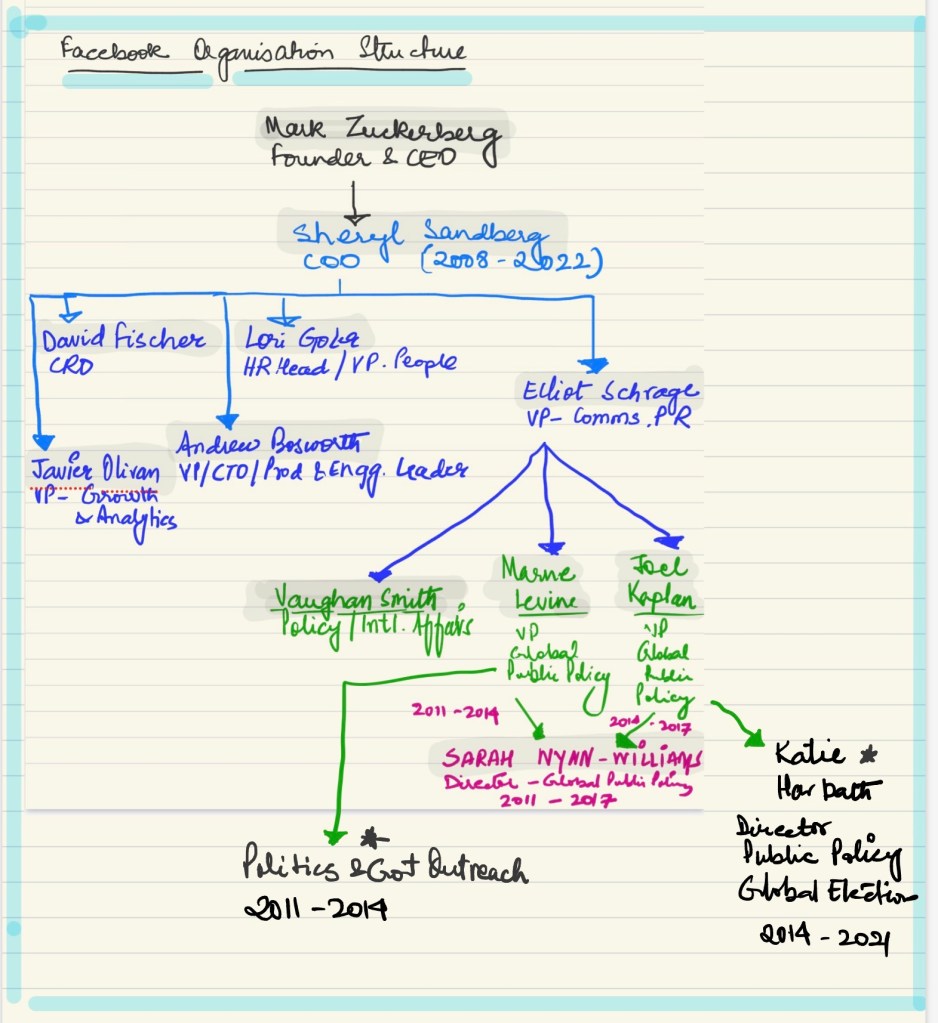
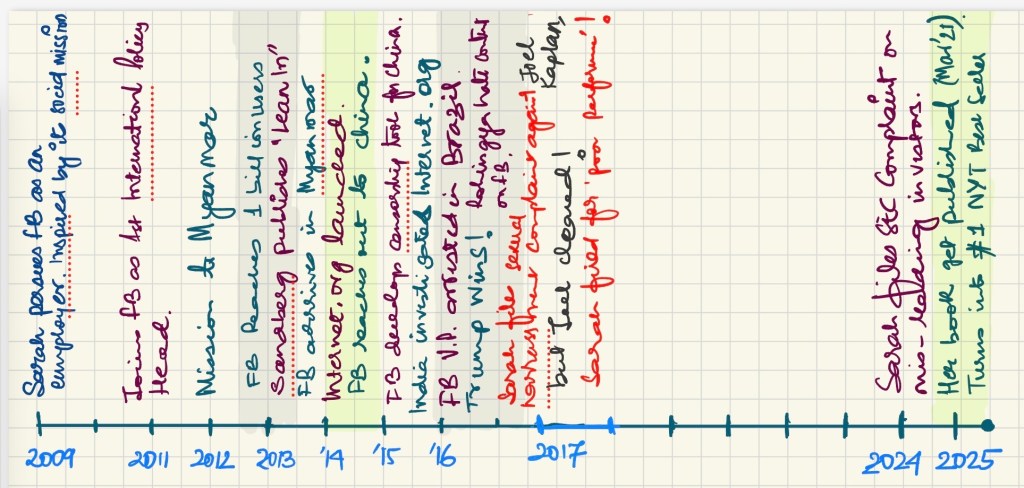
Below are my sketch notes for prospective readers.
Facebook Organisation Structure at that time:
Timelines:
It’s not a product book but a people & culture book; however, read it to learn about the people & ethical aspects of some interesting Facebook-stuff, i.e., the “Little Red Book”, Internet.org / Free Basics, the #AllyBot, the “Feminist Fight Club”, the Political Sales Team, the CCP Censorship Tool / “Chief Editor” System and the Great Firewall Compatibility Tools.
I consider it a must-read, regardless of whether one agrees with every detail presented.
The book has some important organisational, cultural and leadership takeaways. Here are 5 of them:
1. Founder-controlled company vs. founder-led
The most fundamental takeaway is the danger Wynn-Williams, in a rhetorical flourish, calls “Facebook is an autocracy of one.” The distinction between a founder-led company and a founder-controlled one is critical. Zuckerberg held super-voting shares, which meant that no board, no investor pressure, and no employee feedback could compel him to act against his instincts. As Wynn-Williams cites through various examples, the entire organisation took its direction from one person’s appetite for growth and comfort with risk.
2. Personal drive vs. institutional values
Leaders who elevate personal drive over institutional values create an organisational purpose and values vacuum — one that, predictably, gets filled by the next most powerful incentive: revenue growth. The organisation does not lose its north star by accident. It loses it because the founder’s obsessions leave no space for competing values. Speed, growth, and disruption, when celebrated as moral goods, imply that anything that slows them down — ethical review, risk assessment, cultural sensitivity — is implicitly framed as a failure of ambition.
3. Suppression vs. Self-correction
The response to internal feedback or dissent — whether formal (whistleblowing) or informal (repeated sharing of concerns) — should not be suppression or an attempt to manage optics, but rather an effort to address the core issues and self-correct. Organisational energies often go into containing the noise rather than fixing the problem.
An organisation that responds to ethical failures primarily through communications strategy is not managing risk — it is deferring and compounding it. The reputational damage that eventually arrives is always larger than the corrective action that was avoided.
4. Posters vs. Practice
Leadership values must be demonstrated consistently through actions, not just displayed on office walls. Employees observe leaders’ behavior in everyday moments more closely than formal communications.
5. Central decisions vs. local empowerment
Organisations operating across diverse contexts should establish genuine ground-level authority in decision-making. Local and regional employees must be empowered to customise products, programs, and policies. The organisational structure should reflect this global distribution.
Sarah Wynn-Williams has shown considerable courage in sharing her story, and it is an important one.
Do read it.
(Also read this article written by Sabhanaz Rashid Diya, a former head of public policy for Bangladesh at Meta, reviewing Careless People from the perspective of someone who worked in the regions the book largely ignores. https://restofworld.org/2025/careless-people-book-review-facebook-global-policy/ )

